

If you have a limited marketing budget, deciding where to spend it can be frustrating.
Put $500 into Google Ads and you could potentially start receiving visitors almost immediately. Put the same amount into SEO and you might not see a dramatic change tomorrow — but the work you're doing could continue contributing to your visibility months later.
So which is better?
For most small businesses, the answer isn't simply SEO or Google Ads. They perform different jobs, and understanding that difference can prevent you from wasting a substantial amount of your marketing budget.
The simplest way to understand the difference
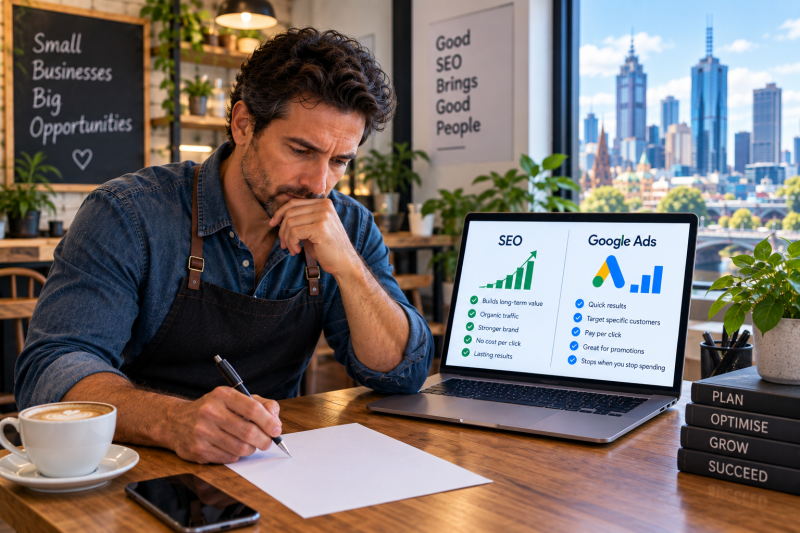
Think of Google Ads as renting visibility.
SEO is more like building it.
With Google Ads, you pay Google to place your business in sponsored positions for particular searches. Every click can cost money, and when you stop advertising, that paid visibility stops too.
With small business SEO, you're improving your own website and its authority so that Google has more reason to show it organically.
That takes longer.
But you aren't paying Google every time somebody clicks an organic result.
That fundamental difference explains why both channels can be valuable.
Where Google Ads has a major advantage: speed
If you've just launched a business and need enquiries this week, SEO probably isn't going to deliver them immediately.
Google Ads potentially can.
You can create a campaign, choose the searches you want to target and begin appearing in sponsored results relatively quickly.
That makes paid search particularly useful for:
- newly launched businesses
- seasonal promotions
- new services
- businesses needing leads immediately
- testing whether a particular service generates demand
It can also provide useful information about the searches that actually produce enquiries.
But there is an obvious catch.
You're paying for that traffic.
The problem with relying entirely on paid advertising
Imagine you're spending $2,000 each month on advertising.
If it generates profitable business, that may be money very well spent.
But what happens when you turn it off?
Your advertising disappears.
This creates a dependency that some small businesses don't realise they're building.
If your website has little organic visibility, reducing the advertising budget can result in a sudden drop in leads.
That's one reason Google visibility outside paid advertising can become valuable.
SEO provides another route through which customers can discover you.
SEO works differently
SEO attempts to improve the visibility of pages your business owns.
That can involve:
- improving website structure
- optimising important service pages
- researching relevant searches
- improving internal linking
- fixing technical problems
- creating useful content
- strengthening local signals
- earning relevant backlinks
Unlike an advertisement, these improvements don't automatically disappear when the monthly advertising budget ends.
A useful article written six months ago can still attract visitors today.
A properly optimised service page can continue appearing for relevant searches.
A stronger website architecture can benefit every piece of content you publish afterwards.
That's where SEO's longer-term value comes from.
But SEO isn't free traffic
This is a misconception worth clearing up.
Organic clicks don't have a direct cost-per-click, but achieving those rankings requires work.
Someone needs to research keywords, improve pages, solve technical issues, produce content, monitor performance and build authority.
Whether you do that yourself or pay for SEO services, there is a cost involved.
The difference is where the investment goes.
With advertising, you're purchasing traffic.
With SEO, you're investing in the digital asset producing the traffic.
What happens after six months?
This is where the comparison becomes more interesting.
Suppose Business A spends its entire search budget on advertising.
Business B invests part of its budget into affordable SEO.
After six months, Business A may have generated plenty of clicks, but it still needs to keep buying them.
Business B may have improved several service pages, published useful articles, built stronger internal links, gained relevant backlinks and improved its local search presence.
Business B isn't guaranteed to outrank Business A, and SEO results vary considerably.
But it has been building something that can potentially continue producing value.
That's the compounding effect that makes SEO attractive as a longer-term strategy.
What about local businesses?
For a local business, the distinction becomes even more interesting.
Someone searching for:
electrician near me
may see paid advertisements, local map results and conventional organic results on the same search page.
That gives businesses several potential routes to visibility.
A strong Local SEO strategy can improve your presence in location-based searches, while Google Ads can provide additional paid exposure for particularly valuable searches.
For many Melbourne businesses, appearing prominently in Maps and organic results can be especially valuable because customers are often looking for a provider they can contact immediately.
LabRank Digital's current Local SEO service, for example, focuses on Google Business Profile optimisation and Australian directory citations to strengthen these local signals.
Which produces better-quality leads?
Neither automatically wins.
Lead quality depends heavily on the searches you're targeting.
A badly configured advertising campaign can generate plenty of clicks from people who were never likely to buy.
SEO can make exactly the same mistake.
Ranking number one for an informational phrase doesn't necessarily generate customers.
That's why keyword research should focus on intent rather than simply search volume.
A search performed by 100 people who genuinely need your service can be considerably more valuable than a broad phrase searched by 10,000 people with little buying intent.
There's another player now: AI search
The SEO-versus-Ads conversation is also becoming broader because Google is no longer the only place people search.
Potential customers increasingly ask AI systems questions such as:
"Who provides affordable SEO for a small business in Melbourne?"
or:
"Find me a local accountant specialising in small businesses."
This creates another reason to invest in the quality and clarity of your website.
AI search visibility depends on systems being able to understand what your business does, who it serves and whether available information about it appears credible.
There is no legitimate way to guarantee that an AI platform will recommend a particular business.
However, many of the fundamentals that support conventional SEO — clear content, good site structure, authority, consistency and useful information — can also make your business easier for AI systems to understand.
LabRank's own approach deliberately treats Google and AI visibility as increasingly connected rather than completely separate strategies.
So where should a small business put $1,000?
Let's use a hypothetical example.
You have $1,000 each month available for search marketing.
Option 1: Spend everything on Google Ads
This could make sense if you urgently need leads and already have a website that converts visitors effectively.
The downside is continued dependence on advertising.
Option 2: Spend everything on SEO
This could make sense if you can tolerate a slower start and want to develop organic visibility over time.
The downside is that SEO rarely provides immediate results.
Option 3: Combine the two
For many businesses, this is potentially the most sensible approach.
Advertising can generate immediate exposure while SEO gradually develops organic visibility.
As organic performance improves, you can reassess how heavily you need to depend on paid traffic.
There isn't a universal percentage split because margins, competition and customer value vary enormously between businesses.
Before spending money on either, fix the destination
There's another issue that is frequently overlooked.
Your website.
It doesn't matter whether a visitor arrives through an advertisement or an organic Google result if the page they land on is confusing.
If your website:
- doesn't clearly explain the service
- loads poorly on mobile
- hides the phone number
- provides little evidence of trust
- has confusing navigation
- doesn't tell visitors what to do next
then buying additional traffic may simply mean paying to show more people a weak page.
That's why on-page SEO and conversion fundamentals should come before obsessing over traffic numbers.
LabRank's current SEO model similarly treats on-page optimisation as an important foundation rather than relying solely on off-page activity.
Don't make this decision based on ideology
SEO agencies naturally talk about the benefits of SEO.
Advertising agencies naturally talk about paid advertising.
Your business doesn't need to join either camp.
It needs customers.
Google Ads is a powerful tool for buying immediate visibility.
SEO is a strategy for developing organic visibility and strengthening the website you own.
Used intelligently, they can complement each other.
The bottom line
If you need leads immediately, Google Ads has an obvious advantage.
If you're thinking about where you want your business to be six, twelve or twenty-four months from now, small business SEO deserves serious consideration.
And if your budget permits it, you don't necessarily have to choose.
Use advertising to capture demand now while steadily building an organic presence that can reduce your reliance on paid clicks over time.
For a small Melbourne business competing against companies with much larger advertising budgets, that combination can be far more realistic than trying to outspend them indefinitely.
Add comment
Comments