

SEO can become unnecessarily complicated.
Spend enough time reading about it and you'll encounter algorithms, entities, authority signals, schema, backlinks, Core Web Vitals, topical relevance, crawl budgets and an apparently endless collection of acronyms.
For a small-business owner, that can make Google feel like a machine that needs to be tricked.
But there's a much simpler way to look at it.
When somebody searches for a service, Google wants to provide results that are relevant, useful and trustworthy.
So rather than beginning with:
"How do I get Google to rank my website?"
try asking:
"If somebody landed on my website looking for this service, would they genuinely find what they needed?"
That question exposes a surprising number of SEO problems.
Imagine you're the customer for five minutes
Let's say you need someone to repair a leaking roof in Melbourne.
You search Google and open a roofing company's website.
The homepage says:
Welcome to ABC Solutions. Delivering quality outcomes through professional solutions tailored to your individual requirements.
That's wonderfully corporate.
It also tells you almost nothing.
Do they repair roofs?
Do they work on residential properties?
Do they service your suburb?
Can they fix a leak?
You shouldn't need to investigate a website like a detective.
A strong small-business website makes the important information obvious.
Tell people what you actually do
This sounds ridiculously basic, but it's one of the most common problems on business websites.
Companies become so familiar with their own services that they forget customers don't have the same background knowledge.
A heading such as:
Solutions Designed Around You
could mean almost anything.
Compare that with:
Residential Roof Repairs Across Melbourne
The second version isn't particularly clever.
That's precisely why it works.
Customers understand it.
Google understands it.
And increasingly, AI systems attempting to understand businesses have clearer information to work with too.
Good on-page SEO often begins with clarity rather than cleverness.
Give important services their own space
Imagine a builder provides:
- bathroom renovations;
- kitchen renovations;
- home extensions;
- decking;
- pergolas.
Putting all five services into a single paragraph on the homepage isn't particularly helpful.
Each important service can usually justify its own useful page.
Not because Google demands that you manufacture pages.
Because somebody researching a bathroom renovation probably wants considerably more information than:
"We also do bathrooms."
A useful bathroom-renovation page might explain the process, typical considerations, the types of projects undertaken, service areas and common customer questions.
That gives Google much more context.
More importantly, it gives the potential customer something worth reading.
Answer the questions people ask before they call you
This is where small businesses have an advantage over generic content writers.
You actually talk to customers.
You know what they ask.
A mortgage broker might constantly hear:
How much deposit do I need?
A landscaper might hear:
How much does a backyard renovation cost?
An accountant might hear:
Should I operate as a sole trader or company?
A removalist might hear:
How long will my move take?
Those questions can improve service pages, FAQs and articles.
They also happen to reflect the increasingly conversational way people search.
Instead of typing two or three words into Google, people can now ask detailed questions through traditional search and AI search interfaces.
The businesses providing genuinely useful answers have more information available to be discovered and understood.
Make your location obvious
For local businesses, geography matters.
If you're a plumber servicing Melbourne's eastern suburbs, say so.
If you only work within a particular radius, explain it.
If customers visit your premises, make the address easy to find.
Your website shouldn't force Google — or customers — to guess where you operate.
This works alongside your Google Business Profile and other Local SEO signals to create a clearer picture of the business.
There's an important distinction here, though.
Being locally relevant doesn't mean writing:
Melbourne plumber providing Melbourne plumbing to Melbourne customers requiring Melbourne plumbers in Melbourne.
That's not optimisation.
That's just unpleasant writing.
Mention locations naturally where they're genuinely relevant.
Show evidence that you're a real business
Trust is difficult to manufacture with a paragraph claiming:
"We are Melbourne's most trusted..."
Trusted by whom?
Instead, show evidence.
Depending on the business, that could include:
- genuine customer reviews;
- completed projects;
- photographs of actual work;
- industry memberships;
- qualifications;
- licences;
- years of experience;
- named team members;
- clear contact details;
- case studies.
Specific evidence is considerably more persuasive than generic claims.
This matters to customers first.
That's reason enough to do it.
Don't hide everything behind beautiful design
Modern websites can look spectacular.
Full-screen videos.
Animations.
Minimalist menus.
One-word headings.
Huge photographs.
None of these things are inherently bad.
Problems arise when visual design starts removing useful information.
If your homepage consists almost entirely of photographs and phrases such as Imagine, Transform, Experience and Discover, you may have created a beautiful website that doesn't adequately explain the business.
Design should support communication rather than replace it.
A website can be visually impressive and informative.
Make navigation boringly obvious
Here's another area where creativity isn't always your friend.
Customers understand menu labels such as:
Services
About
Contact
Pricing
Locations
Calling your services page Possibilities may sound sophisticated, but visitors now have to work out what "Possibilities" means.
The same principle applies to site structure.
Important pages should be reasonably easy to reach.
Related pages should connect through sensible internal linking.
If you've written an article about the cost of bathroom renovations, linking naturally from that article to your bathroom-renovation service makes sense.
You're helping the visitor continue their research.
The SEO benefit follows the logic rather than replacing it.
Don't create pages purely because a keyword tool told you to
Keyword data is useful.
It can reveal how people describe services and uncover searches you hadn't considered.
But keyword research should inform your website rather than dictate nonsense to it.
Suppose a tool shows searches for:
- cheap accountant Melbourne;
- affordable accountant Melbourne;
- low cost accountant Melbourne;
- budget accountant Melbourne.
You probably don't need four nearly identical pages.
A strong page can naturally cover the underlying subject.
Creating dozens of thin pages that say essentially the same thing isn't improving the website.
What about backlinks?
Even an excellent website doesn't exist in isolation.
Google can also consider signals beyond your site.
One important area is backlinks — links from other websites to yours.
Think about them less as points in a game and more as references.
If relevant, credible websites reference your business or content, that can contribute to the broader picture of your site's authority.
This is why 10 meaningful links can be more interesting than 1,000 random ones.
For small businesses working with an affordable SEO budget, quality and relevance matter because resources are limited.
There's little value in spending those resources accumulating impressive-looking numbers that don't strengthen the business.
Google doesn't need you to update your website every Tuesday
Another persistent SEO myth is that websites must constantly publish something so Google knows they're "active".
Useful updates make sense.
Updating your opening hours makes sense.
Improving an outdated service page makes sense.
Publishing an article answering a genuine customer question makes sense.
Publishing 500 words of filler because it's Tuesday doesn't.
Your website isn't a hungry pet that needs to be fed content on a schedule.
Quality and usefulness are better objectives than arbitrary frequency.
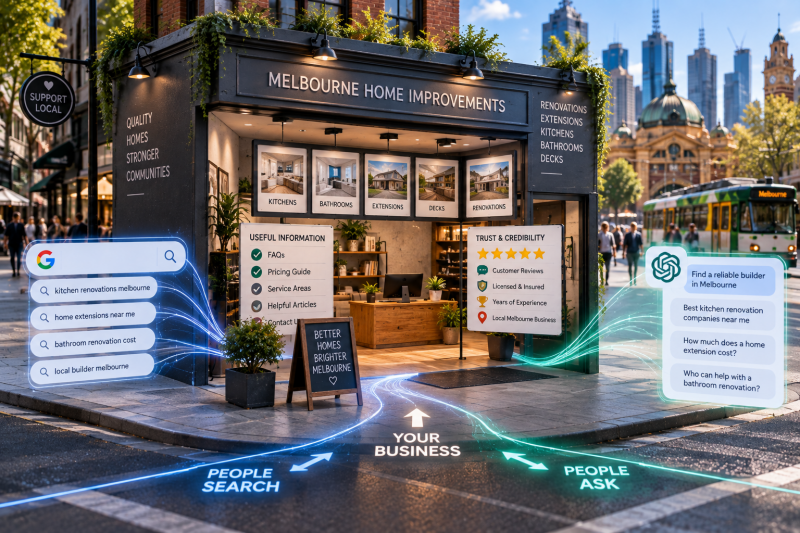
What does this mean for AI search?
The search landscape is expanding beyond the traditional list of ten blue links.
People increasingly ask AI-powered systems things such as:
"Find an affordable SEO company for a small business in Melbourne."
Or:
"What should I look for when choosing a local landscaper?"
No business can guarantee that an AI system will mention it.
But consider what these systems need in order to understand a business.
Clear information about services.
Clear geographic context.
Useful explanations.
Consistent business details.
Evidence and references.
Logical relationships between information.
Sound familiar?
A lot of the fundamentals that help traditional search also create a clearer digital footprint for AI search visibility.
The interface is changing.
Being understandable remains valuable.
A simple website test
You don't need an SEO tool for this.
Open your homepage and give yourself 10 seconds.
Then close it.
Can you answer these questions?
What does this business do?
Who is it for?
Where does it operate?
What should I do next?
Now open one of your major service pages.
Can you understand exactly what the service involves?
Does it answer obvious customer questions?
Can you easily find related information?
Is there a clear next step?
If the answers are mostly yes, you've already got something useful to work with.
If they're mostly no, that's where I'd start.
Stop trying to impress Google
Google isn't a potential customer.
People are.
The objective of small business SEO shouldn't be to fill a website with things supposedly designed to impress an algorithm.
It should be to make your business easier to discover, understand and evaluate.
Clear pages.
Useful information.
Logical structure.
Relevant local signals.
Credible external references.
A good experience once somebody arrives.
SEO becomes much less mysterious when you look at it that way.
And conveniently, the website that makes sense to Google is usually a much better website for the customer as well.
Add comment
Comments