

There's a particular type of Google search that should matter enormously to a local business.
It usually contains some variation of:
"near me"
"Melbourne"
or the name of a suburb.
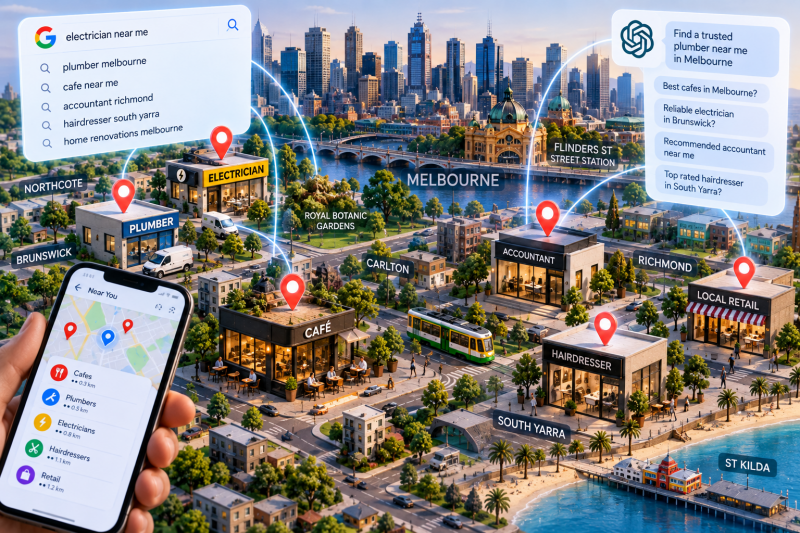
People search for electrician near me, accountant Melbourne, dentist Richmond, plumber Brunswick and thousands of similar combinations every day.
But here's what's interesting.
Google doesn't always need somebody to type a location at all.
Search for "coffee shop" while standing in Melbourne and Google understands that a café in Perth probably isn't particularly useful.
Location has become part of the search itself.
For small businesses serving a defined area, that makes Local SEO one of the most practical parts of search marketing to understand.
Local SEO isn't just normal SEO with "Melbourne" added everywhere
This misconception produces some truly terrible websites.
You've probably encountered pages containing sentences like:
"Our Melbourne plumbers provide Melbourne plumbing services to Melbourne customers looking for the best plumber in Melbourne."
Nobody speaks like that.
And repeating Melbourne 47 times doesn't magically convince Google that your business belongs there.
Local search is about creating a consistent collection of signals showing what your business does, where it operates and whether it appears credible.
Your website is one of those signals.
Your Google Business Profile is another.
Business directories can contribute.
Reviews can contribute.
Links and references from relevant websites can contribute.
Your overall local presence is the bigger picture.
Your Google Business Profile matters
For many local businesses, the Google Business Profile is one of the most visible pieces of online real estate they have.
It's what can appear alongside map results with information such as:
- business name;
- address or service area;
- opening hours;
- telephone number;
- website;
- photographs;
- reviews;
- business category.
Yet plenty of businesses create a profile once and barely look at it again.
Information changes.
Hours change.
Services change.
Businesses move.
Photos become outdated.
Categories may not accurately describe what the company actually does.
Maintaining accurate information sounds incredibly mundane.
It is.
It's also useful.
If Google is trying to recommend an appropriate local business, giving it accurate information seems like a sensible place to start.
Your website still matters
Having a Google Business Profile doesn't make the website irrelevant.
They complement one another.
Suppose you're an electrician operating throughout Melbourne's northern suburbs.
Your website should make that reasonably obvious.
Not by creating hundreds of nearly identical pages for every suburb imaginable, but by clearly explaining:
what electrical services you provide;
which areas you genuinely service;
what types of customers you work with;
and
how somebody can contact you.
This is where on-page SEO becomes important.
Google shouldn't have to piece together your business model from vague marketing slogans.
If you provide emergency electrical repairs in Coburg, Preston and surrounding suburbs, your website should contain enough useful information for a person — and a search engine — to understand that.
Don't create 100 rubbish suburb pages
This deserves its own section because it's still common.
A business wants to rank across Melbourne, so somebody creates:
Plumber Richmond
Plumber Carlton
Plumber Fitzroy
Plumber Brunswick
Plumber Preston
and another 70 pages.
Every page contains essentially the same paragraph with the suburb changed.
That's not a particularly useful local strategy.
There are situations where dedicated location pages make perfect sense.
If you have physical locations in different areas, absolutely.
If different service areas genuinely require substantially different information, possibly.
But manufacturing thin pages purely to insert suburb names creates very little value for customers.
A smaller number of genuinely useful pages is usually a much stronger foundation.
Reviews do more than make the stars look nice
Think about your own behaviour.
You're choosing between two unfamiliar businesses.
One has dozens of detailed reviews discussing actual experiences.
The other has three reviews, all saying:
"Great service!"
Which one gives you more confidence?
Reviews provide social proof.
They also give potential customers information the business can't credibly provide about itself.
A company can tell you it's reliable.
A customer explaining that the electrician arrived when promised, explained the problem clearly and cleaned up afterwards is much more persuasive.
That doesn't mean chasing reviews aggressively or attempting to manipulate them.
It means making it easy for genuine customers to share genuine experiences.
Consistency is boring — and important
Imagine your business is listed online as:
Smith & Jones Plumbing Pty Ltd
But elsewhere it's:
Smith and Jones Plumbing
Another directory has your previous telephone number.
Facebook has an old address.
Your website lists opening hours that don't match your Google profile.
None of these inconsistencies necessarily destroys your visibility overnight.
But collectively they create unnecessary ambiguity.
Keeping your core business details reasonably consistent across important platforms helps create a clearer digital identity.
This is part of what LabRank's Local SEO service addresses through Google Business Profile optimisation and relevant directory listings.
Local SEO can give smaller businesses a fighting chance
One of the most appealing things about local search is that relevance can narrow the competitive field.
A small Melbourne electrician probably isn't going to compete nationally with Australia's largest home-services companies for every broad electrical search.
Fortunately, they don't necessarily need to.
Their customers are usually somewhere nearby.
That changes the contest.
Being highly relevant to a particular service and location can create opportunities that wouldn't exist in a national search.
This is why small business SEO should focus on realistic opportunities rather than vanity keywords.
Ranking for a glamorous keyword nobody converts from isn't particularly useful.
Being discovered by somebody five kilometres away who needs exactly what you sell is.
"Near me" searches aren't about putting "near me" on your website
Please don't create a page titled:
Best Accountant Near Me
Near whom?
The phrase works because Google uses information about the searcher's location.
Your job is to provide accurate information about your location and service area.
Google handles the "me" part.
This sounds obvious when explained that way, but businesses still optimise pages for phrases such as "plumber near me" as though they're writing from the customer's perspective.
Focus instead on describing your business accurately.
What if you don't have a shopfront?
Local SEO isn't limited to cafés, retailers and businesses customers physically visit.
Plumbers.
Electricians.
Cleaners.
Landscapers.
Mobile mechanics.
Pest-control companies.
Removalists.
Many service-area businesses travel to their customers.
Their local presence still matters because geography determines who they can realistically serve.
The way the business is represented online may differ from a traditional storefront, but the fundamental question remains:
Where can this company actually provide its service?
Make that answer clear.
Local content can help — when it's actually local
Here's another area where businesses can get carried away.
You don't need to publish an article every week containing "Melbourne" in the title.
But genuine local knowledge can make content more useful.
A landscaper might discuss plants suited to Melbourne conditions.
A builder might explain Victorian renovation considerations.
An accountant could discuss issues particularly relevant to Victorian small businesses.
A removalist could create a genuinely useful guide to moving between particular areas.
The location becomes part of the usefulness rather than a keyword pasted onto generic content.
That's a much healthier way to approach local SEO Melbourne content.
Local search is moving beyond Google Maps
This is where things become particularly interesting.
Imagine somebody asks an AI assistant:
"I'm looking for a reasonably priced accountant for my small café in Melbourne. What should I look for?"
Or:
"Find electricians servicing Brunswick that specialise in older homes."
These aren't necessarily traditional keyword searches.
They're conversations.
Businesses therefore need to think beyond whether one particular keyword ranks at position four or position seven.
Can digital systems understand:
who you are?
what you do?
where you operate?
what you're particularly good at?
whether credible sources reference you?
This is where traditional SEO and AI search visibility increasingly overlap.
Nobody can guarantee that ChatGPT, Google AI or another system will recommend a particular business.
But making your business clearer and more authoritative online gives these systems better information to work with.
Local SEO doesn't have to cost thousands every month
This is particularly important for small businesses.
Local optimisation doesn't need to become an enormous enterprise marketing project.
The fundamentals are quite practical.
Get the website right.
Get the Google Business Profile right.
Make your services and locations clear.
Build a sensible directory presence.
Earn genuine reviews.
Develop relevant authority.
Measure what's changing.
That's why LabRank Digital positions its services around affordable SEO rather than trying to recreate an enterprise SEO campaign on a small-business budget.
Our Local SEO package is $399 per location, covering Google Business Profile optimisation plus listings in five relevant directories.
Ongoing SEO is separate because building organic visibility is an ongoing process rather than a one-off profile update.
One final test
Take out your phone.
Search Google for the main service your business provides.
Don't search your company name.
Search the way a customer would.
Then try a couple of variations.
Add your suburb.
Try Melbourne.
Look at the map results.
Look at the organic results.
Now look at the businesses appearing ahead of you.
Don't immediately ask:
"How do I beat them?"
Ask:
"What information is Google getting from these businesses that it might not be getting from mine?"
Look at their websites.
Look at their Google profiles.
Look at their reviews.
Look at how clearly they explain their services.
Look at the information surrounding them elsewhere online.
You may discover that local SEO isn't particularly mysterious after all.
It's largely about creating enough accurate, useful and credible information for search engines — and customers — to understand that your business is a relevant answer to a local problem.
And for a small business, being the relevant answer nearby can be considerably more valuable than trying to be visible everywhere.
Add comment
Comments