

Imagine you're looking for a plumber, accountant or local electrician. You search Google, find several businesses offering what you need and begin comparing your options. Their websites look professional, their services seem similar and their prices appear reasonable.
So how do you decide which one to contact?
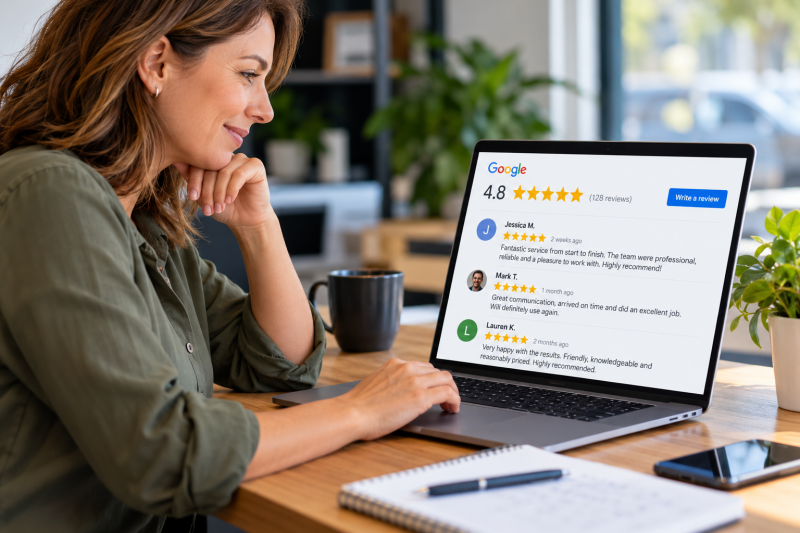
For many people, the next step is to read what previous customers have said about their experiences. A business with a collection of genuine, informative reviews may immediately appear more reassuring than one with little or no customer feedback.
This is why online reviews for small businesses have become an important part of how customers research services and make purchasing decisions.
Reviews are no longer simply an optional addition to a business's online presence. They help prospective customers evaluate businesses they may never have dealt with before, often before those customers have even visited a website.
Why Customers Look for Reviews Before Making Contact
Choosing an unfamiliar business involves an element of uncertainty. Customers want reassurance that the company is legitimate, provides the services advertised and treats people professionally.
A business can make these claims about itself, but potential customers may place greater weight on the experiences of people who have already used its services.
Consider a homeowner searching for someone to repair a leaking roof. Several roofing companies appear in the search results, all offering similar services. One has a handful of reviews, another has numerous detailed reviews describing completed repairs, and a third has no visible customer feedback.
The homeowner may be more inclined to investigate the business with the detailed reviews, particularly if those comments describe experiences relevant to their own situation.
Reviews provide a form of social proof. They allow prospective customers to learn from other people's experiences and reduce some of the uncertainty involved in choosing a service provider.
However, the number of reviews is not necessarily the deciding factor. Their relevance, authenticity and overall quality can be equally important.
A Five-Star Rating Doesn't Tell the Whole Story
It's tempting to assume that customers will automatically choose whichever business has the highest star rating.
In reality, people often look beyond the overall score.
A business with a perfect rating but only three reviews may not necessarily appear more convincing than a competitor with a slightly lower rating supported by numerous detailed customer experiences.
Customers may also pay attention to when reviews were written. A business with consistently positive feedback over several years can present a different impression from one whose most recent review is several years old.
The content of individual reviews matters as well.
A comment such as "Great service" is positive, but it doesn't provide much information about what the business actually did.
Compare that with a customer explaining that an electrician arrived when promised, identified a difficult electrical fault, explained the repair and completed the work professionally.
The second review provides considerably more useful information.
For small businesses, this demonstrates why genuine customer experiences are more valuable than simply chasing a perfect star rating.
How Online Reviews Can Influence Google Visibility
Customer reviews can also contribute to how prominently a business appears in local search results.
When someone searches for a nearby service, Google may display a selection of businesses through Google Maps or its local search results.
Google explains that local rankings are primarily influenced by relevance, distance and prominence. Review numbers and positive ratings can contribute to prominence, although they are only part of the overall assessment.
This means a business with a strong collection of reviews may benefit from improved local visibility, but collecting more reviews does not guarantee a particular ranking.
A business still needs accurate contact information, appropriate business categories, relevant services and a website that clearly explains what it offers.
This is where local SEO becomes particularly important.
A well-maintained Google Business Profile helps customers understand what a business does, where it operates and how to contact it. Reviews add another layer of information that can help customers assess whether the business is suitable for their needs.
At LabRank Digital, our Local SEO Services focus on establishing these essential foundations through Google Business Profile optimisation and consistent business information across relevant online directories.
The objective is to help businesses become easier to discover when potential customers search for their services.
Why Responding to Reviews Matters
Receiving customer reviews is only one part of managing an online reputation.
How a business responds can also influence the impression it creates.
When a customer leaves a positive review, a brief, professional acknowledgement demonstrates appreciation. It also shows prospective customers that the business is engaged with the people it serves.
Negative reviews require a little more consideration.
No business can reasonably expect every customer interaction to be perfect. Delays, misunderstandings and occasional mistakes can occur, even when a business makes a genuine effort to provide excellent service.
What matters is how those situations are handled.
A defensive or argumentative response to criticism may discourage prospective customers. A calm, professional reply that acknowledges the concern and offers an appropriate way to resolve it can create a much better impression.
For example, if a customer complains that an appointment was delayed, the business could acknowledge the inconvenience, explain the situation where appropriate and offer to discuss the matter privately.
The objective should not be to win an argument in public. It should be to demonstrate professionalism and a willingness to address genuine concerns.
Importantly, businesses should avoid disclosing private customer information when responding publicly.
Sometimes a thoughtful response to a negative review can provide prospective customers with more reassurance than another five-star rating.
How Small Businesses Can Encourage More Genuine Reviews
Many satisfied customers simply don't think about leaving a review.
They may have received excellent service, paid their invoice and continued with their day without considering how valuable their feedback could be to the business.
Fortunately, encouraging reviews doesn't need to involve complicated marketing campaigns.
A straightforward approach is to make it easy for customers to share their experiences.
Businesses can create a direct Google review link and include it in a follow-up email, thank-you message or receipt. Google also provides QR codes that customers can scan to access the review process.
The request should be polite, uncomplicated and entirely optional.
For example, after completing a job, a business might send a message thanking the customer and inviting them to share an honest review of their experience.
There is no need to pressure customers or ask them to provide a particular rating.
Businesses should also be careful about offering rewards in exchange for reviews.
Google prohibits incentives for reviews on its platform, including discounts, payments or free products and services. It also prohibits selectively requesting positive reviews while discouraging negative feedback.
In Australia, businesses must also comply with consumer protection laws relating to misleading reviews.
The Australian Competition and Consumer Commission's guidance on online reviews explains that reviews should reflect genuine customer experiences and that creating or arranging misleading reviews is unlawful. ACCC
For small businesses, the safest and most sustainable approach is to encourage honest feedback from real customers without attempting to influence what they say.
Reviews Can Also Improve Your Website's Credibility
Although Google reviews are particularly visible in local search results, customer feedback can also play a useful role on a business's own website.
A service page might explain what a business offers, how the service works and why someone should consider using it.
Including a genuine customer testimonial can provide additional reassurance by demonstrating how that service has helped someone in practice.
For example, a landscaping company might include a testimonial from a homeowner describing the experience of having a garden redesigned. A bookkeeping business could feature feedback from a client who appreciated the clarity of its financial reporting.
These examples help prospective customers understand what working with the business might actually involve.
However, testimonials should never replace clear information about the services themselves.
A website still needs to explain what the business does, who it helps, where it operates and how customers can make contact.
Customer feedback works best when it supports useful website content rather than attempting to compensate for information that is missing.
Businesses should also obtain appropriate permission before displaying identifiable customer testimonials and ensure that quotations accurately represent what customers have said.
What About AI Search Engines?
As AI-assisted search becomes more common, businesses are understandably interested in whether online reviews influence the recommendations these systems provide.
AI search systems may use information from websites, business listings and other publicly available sources when generating answers. Depending on the system and search, this can include information associated with customer feedback.
However, there is no reliable basis for claiming that collecting a particular number of reviews will cause an AI search engine to recommend a business.
Different AI search platforms gather, interpret and present information in different ways.
What businesses can reasonably focus on is maintaining an accurate, informative and trustworthy online presence.
A clearly structured website, consistent business information, relevant service descriptions and authentic customer feedback all help establish a more complete picture of a business online.
These are worthwhile improvements regardless of whether a customer discovers the business through traditional Google results, Google Maps or an AI-assisted search experience.
Reviews Are Important, but They're Not a Complete SEO Strategy
A business could have hundreds of positive reviews and still struggle to attract relevant visitors to its website.
This can happen when the website has technical problems, poorly written service pages, confusing navigation or insufficient information about the services being offered.
Similarly, a business might appear in local search results but fail to generate enquiries because its website makes contacting the company unnecessarily difficult.
Reviews help establish confidence, but customers still need a clear reason to choose the business and a straightforward way to get in touch.
This is why a broader SEO strategy remains important.
Effective SEO involves improving how search engines understand a website, targeting relevant search terms, developing useful content and addressing technical or structural issues that may limit visibility.
For small businesses working with limited marketing budgets, these improvements should be prioritised according to their likely value rather than pursued simply because competitors are doing them.
Our affordable SEO plans are designed around this principle, helping small businesses improve their online visibility through practical, ongoing optimisation without the expense of a traditional large-agency arrangement.
Building Trust Is an Ongoing Process
Online reviews are valuable because they reflect something businesses cannot establish through advertising alone: the experiences of real customers.
A professional website may create a strong first impression, but authentic feedback can help prospective customers feel more confident about taking the next step.
For small businesses, building a positive online reputation doesn't require elaborate campaigns or expensive software. It begins with providing reliable service, treating customers professionally and making it easy for people to share their experiences.
Over time, a consistent collection of genuine reviews can become a useful asset that supports both customer confidence and local search visibility.
The important thing to remember is that getting found online and being chosen by a customer are two different challenges.
Good SEO helps people discover your business. A trustworthy online reputation can help give them the confidence to contact you.
At LabRank Digital, we believe small businesses deserve practical, affordable SEO that addresses both visibility and the experience customers have when they find a business online.
Because attracting more relevant visitors is valuable, but helping those visitors feel confident enough to make an enquiry is what makes that visibility worthwhile.
Add comment
Comments