

When someone visits your business website, they're usually looking for something specific. They might want to know how much a service costs, whether you operate in their area, how long a job will take or what happens after they make an enquiry.
If they cannot find that information quickly, they may leave your website and continue searching elsewhere.
For small businesses, this presents a challenge. Your website needs to provide enough information to help potential customers make decisions without overwhelming them with lengthy explanations or complicated navigation.
One practical solution is a frequently asked questions page, commonly known as an FAQ page.
Although an FAQ page might seem like a relatively minor addition to a website, it can play a useful role in improving customer experience, reducing unnecessary enquiries and supporting your broader search engine optimisation strategy.
However, not every business needs a separate FAQ page, and simply adding a collection of questions won't automatically improve your Google rankings.
The real value comes from answering the questions your customers genuinely want answered.
What Is an FAQ Page?
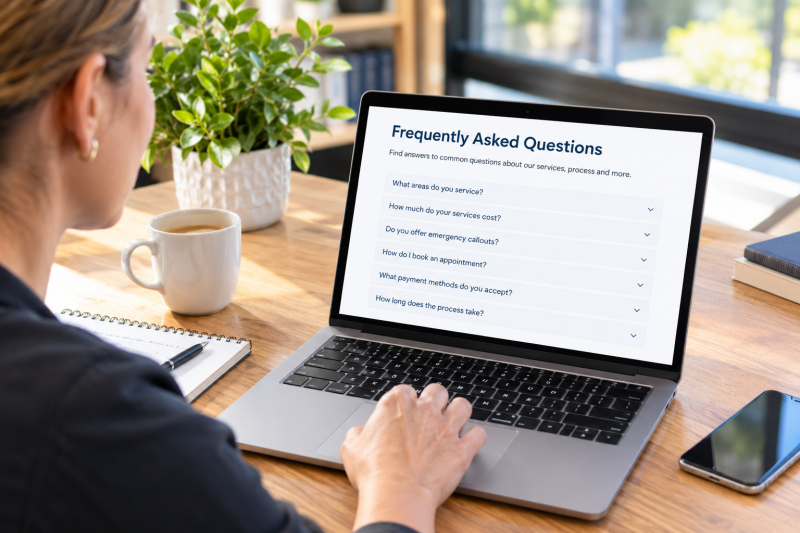
An FAQ page is a section of a website dedicated to answering questions that customers regularly ask about a business, its products or its services.
These questions generally concern practical information that people need before making a purchase, requesting a quote or booking an appointment.
For example, a plumbing business might answer questions about emergency callouts, service areas, appointment availability and whether customers receive a written quote before work begins.
An accounting firm might explain what documents clients should bring to their first appointment, whether consultations are available online and which types of businesses it works with.
A landscaping company could address questions about project timelines, maintenance requirements and whether it provides services outside its immediate suburb.
The purpose is straightforward: make useful information easy to find before customers need to ask for it.
A good FAQ page should feel like a helpful conversation with someone who understands the business, rather than a collection of marketing statements.
Why Frequently Asked Questions Matter to Customers
Most people want to feel reasonably confident about a business before making contact.
They may have found your website through Google, a recommendation or an online advertisement, but that doesn't necessarily mean they're ready to become a customer.
Often, they still have questions.
Consider someone looking for a local electrician. They find a business with a professional website, read about its services and decide it might be suitable.
However, they cannot determine whether the electrician services their suburb, provides after-hours appointments or handles the particular electrical problem they're experiencing.
Rather than calling to ask three separate questions, they might return to Google and investigate another business.
A well-organised FAQ section could provide those answers immediately.
This doesn't mean every visitor will read your FAQs or that answering questions guarantees additional enquiries. It simply removes some of the uncertainty that can prevent people from taking the next step.
For businesses competing against larger operators, making information accessible can be particularly valuable.
You may not have the advertising budget of a national company, but you can still provide a clear, professional and informative website that makes dealing with your business straightforward.
Can an FAQ Page Help Your SEO?
An FAQ page can support search engine optimisation, although its benefits are sometimes misunderstood.
Search engines aim to provide users with relevant information that addresses their searches. When a website contains clear explanations of its services, processes and policies, it provides additional context about what the business offers.
An FAQ page can contribute to that information.
For example, someone might search for "Do plumbers charge a callout fee?" or "How long does a bathroom renovation take?"
If a business has published a useful answer to a relevant question, that content may be suitable for inclusion in search results.
However, whether Google displays the page depends on numerous factors, including the relevance and quality of the content, competition and how effectively the website can be crawled and indexed.
Google's guidance emphasises creating content that genuinely helps people rather than producing pages primarily to attract search engine traffic.
This is an important distinction.
Adding twenty questions simply because they contain popular keywords is unlikely to be as useful as providing thoughtful answers to ten questions customers regularly ask.
The objective should be to improve the information available on your website, with potential search visibility benefits following from that improvement.
What Happened to Google's FAQ Rich Results?
You may have previously noticed Google search results displaying expandable questions and answers directly beneath a website listing.
These were known as FAQ rich results.
For several years, businesses could use structured data to help Google identify frequently asked questions on their websites.
However, Google's treatment of this feature has changed considerably.
In August 2023, Google restricted FAQ rich results primarily to authoritative government and health websites. On 7 May 2026, Google discontinued FAQ rich results entirely, with the associated reporting and testing support subsequently withdrawn.
This means small businesses should no longer create FAQ pages with the expectation that their questions will appear as expandable rich results in Google Search.
Nevertheless, the removal of this particular search feature doesn't make FAQ content unnecessary.
The questions and answers remain valuable to website visitors, and relevant content can still be discovered through ordinary search results.
For small businesses, the priority should remain the usefulness of the information rather than attempting to take advantage of a particular search-result feature.
How FAQ Content Relates to AI Search
With the growing use of AI-assisted search tools, businesses are also asking whether frequently asked questions can help their information appear in AI-generated answers.
There are reasonable grounds for making website information clear and easy to interpret, but it's important to distinguish good content practices from guaranteed AI visibility.
AI search systems may retrieve and summarise information from publicly accessible websites. Clear answers to specific questions can make a business's services, policies and expertise easier for readers and automated systems to understand.
For example, a customer might ask an AI search tool whether a particular type of service is available in their area.
A business website that clearly identifies its services and operating locations provides more useful information than one containing vague promotional language.
However, there is no guarantee that adding an FAQ page will cause an AI platform to recommend or cite your business.
Different platforms use different methods to retrieve and present information, and those methods continue to evolve.
The most sensible approach is to ensure your website provides accurate, accessible and genuinely helpful information.
This benefits visitors regardless of whether they arrive through traditional Google results, an AI-assisted search or another referral source.
What Questions Should Your Business Answer?
The best FAQ questions usually come from customers themselves.
Think about the questions people ask when they telephone your business, send an email or request a quote.
If several customers regularly ask the same question, there's a reasonable chance that other prospective customers would appreciate finding the answer on your website.
Common subjects worth considering include:
- Pricing: Do you provide fixed prices, estimates or individual quotations?
- Service areas: Which suburbs, towns or regions do you service?
- Appointments: How do customers book, and what availability do you offer?
- Processes: What happens after someone requests a quote or makes a booking?
- Payments: Which payment methods do you accept, and when is payment required?
- Service expectations: How long does the work typically take, and what should customers prepare beforehand?
These are starting points rather than a standard list that every business should copy.
A retail business may need to address delivery times and returns, while a professional services business may receive more questions about consultations, documentation and ongoing support.
The answers should also be specific enough to provide genuine value.
For example, a question such as "Do you offer competitive prices?" followed by "Yes, we offer the best prices" tells customers very little.
A more useful answer might explain that quotations are provided after assessing the work, that pricing depends on the scope of the project and that customers receive an itemised estimate before proceeding.
Specific information is generally more helpful than broad marketing claims.
Should You Have a Separate FAQ Page?
Not necessarily.
For some small businesses, a dedicated FAQ page makes sense because there are numerous questions covering different aspects of the business.
For others, placing relevant questions directly on individual service pages may be more useful.
Consider a plumbing company offering blocked drain repairs, hot water system installations and emergency plumbing.
Each service attracts different customer questions.
Someone researching hot water installations may want to know about replacement costs, available systems and installation timeframes.
A customer dealing with a blocked drain may be more concerned about response times, diagnostic methods and whether excavation could be necessary.
Placing those answers on the relevant service pages allows visitors to find information in the context of the service they're considering.
A central FAQ page could still be useful for general questions about appointments, payments, business hours and service locations.
The important consideration is accessibility.
Customers shouldn't have to search through unrelated information to find the answers they need.
For smaller websites, a handful of well-written FAQs on relevant pages may be more effective than creating an entirely separate section containing very little information.
How to Write Effective FAQ Answers
Writing an effective FAQ answer doesn't require complicated language or lengthy explanations.
In most cases, customers appreciate a direct response followed by enough supporting information to understand what it means.
For example, consider the question:
"Do you provide services outside Melbourne?"
An unhelpful answer might simply say:
"Yes, contact us for more information."
A better answer would identify the actual locations the business services, explain whether additional travel charges apply and tell customers how to confirm availability.
This gives the reader practical information while making the next step clear.
It's also important to avoid turning every answer into a sales pitch.
If someone asks whether your business accepts credit cards, they probably don't need several paragraphs explaining why your company provides exceptional customer service.
They want to know whether they can pay by credit card.
Answer the question first, then provide additional information where necessary.
Businesses should also review their FAQs periodically. Pricing arrangements, operating hours, service areas and company policies can change, and outdated answers may create confusion or unnecessary disputes.
FAQs Can Reduce Repetitive Customer Enquiries
Small-business owners often spend considerable time answering the same questions.
While customer communication is essential, repeatedly explaining basic information can take time away from other business activities.
A useful FAQ section can reduce some of these repetitive enquiries.
For example, a cleaning company might receive frequent questions about whether customers need to supply cleaning products, how cancellations work and whether appointments are available on weekends.
Publishing clear answers allows prospective customers to obtain that information whenever they visit the website.
This can be particularly useful outside normal business hours, when someone may be researching services but cannot immediately speak to a staff member.
Of course, FAQs shouldn't replace personal communication entirely.
Some customers will still prefer to telephone or email, particularly when their circumstances are unusual or they need advice about a specific problem.
The objective is to make routine information readily available while keeping personal assistance accessible when it's needed.
How FAQs Fit Into a Broader SEO Strategy
An FAQ page should support your website's existing content rather than replace it.
Your main service pages still need to explain what you offer, who your services are suitable for and why customers should consider your business.
Your contact information should be easy to find, and visitors should be able to navigate the website without unnecessary difficulty.
From an SEO perspective, these fundamentals matter considerably more than simply adding extra questions.
At LabRank Digital, our approach to small-business SEO focuses on establishing practical foundations that help search engines understand a website and make it easier for relevant customers to discover.
This includes identifying appropriate keywords, improving on-page content and addressing technical issues that may affect search visibility.
An FAQ section can complement this work by answering additional questions relevant to the business and its customers.
For businesses serving specific geographic areas, FAQs can also support local information.
A tradesperson might explain which suburbs they service, whether travel charges apply outside their usual area and how customers can arrange appointments.
These answers can complement the accurate business information and Google Business Profile optimisation addressed through our Local SEO Services.
However, simply repeating suburb names throughout an FAQ page is not a substitute for useful local content.
The information should reflect where the business genuinely operates and the services it actually provides.
Avoid Creating Questions Just for Keywords
One of the more common mistakes businesses make is treating FAQs as another opportunity to repeat keywords.
For example, a Melbourne electrician might create several questions that are essentially variations of the same phrase:
"Are you an electrician in Melbourne?"
"Do you provide Melbourne electrician services?"
"Can I hire your Melbourne electrical business?"
Although the wording changes slightly, these questions provide little additional value.
They may also make the page feel unnatural and repetitive.
A better approach would be to address genuinely different subjects, such as electrical safety inspections, emergency availability, switchboard upgrades and service locations.
Relevant keywords will often appear naturally when businesses explain their services clearly.
There is no need to force them into every question or answer.
Search optimisation should improve the usefulness and accessibility of website information, not make the content awkward for customers to read.
How to Know Whether Your FAQ Page Is Working
Once an FAQ page or section has been added, it's worth reviewing whether it provides value.
This doesn't necessarily require complicated analytics.
You can begin by observing whether customers continue asking questions that are already answered on your website.
If people regularly ask about your operating hours despite that information being published, the problem may be that the answer is difficult to find.
Similarly, if customers frequently ask about pricing arrangements, the relevant information may need to be more prominent.
Website analytics can provide additional insights.
You may be able to see whether visitors are accessing your FAQ page, which other pages they visit and whether they subsequently navigate to your contact information.
Google Search Console can also help identify search queries that lead people to your website, although the available data will not necessarily show every search or visitor interaction.
These observations can help determine whether your FAQ content needs to be expanded, simplified or reorganised.
The objective isn't necessarily to attract large numbers of visitors directly to the FAQ page.
Sometimes its greatest value is helping someone who has already discovered your business feel confident enough to make an enquiry.
A Small Improvement That Can Make a Difference
A frequently asked questions page is not essential for every business website, and it shouldn't be treated as a shortcut to higher search rankings.
However, answering common customer questions clearly can improve the experience people have when researching your business.
It can reduce uncertainty, make useful information easier to access and help prospective customers understand whether your services are appropriate for their needs.
For some businesses, that means creating a dedicated FAQ page. For others, it means adding a few carefully selected questions to existing service pages.
Either approach can be worthwhile when the information genuinely helps customers.
The most important thing is to consider your website from the perspective of someone who has never dealt with your business before.
What would they need to know before contacting you? What might make them hesitate? Which questions could you answer now to make their decision easier?
These are the questions worth addressing.
At LabRank Digital, we believe effective SEO should be practical, affordable and focused on improvements that make sense for smaller businesses.
Our SEO pricing plans are designed to help small businesses improve their search visibility without the unnecessary complexity and expense often associated with larger digital marketing agencies.
Because a successful business website shouldn't simply attract visitors. It should provide the information those visitors need to take the next step with confidence.
Add comment
Comments