

You launch a new website, invest time in writing service pages, choose your keywords carefully and make sure everything looks professional. A few months later, you search Google for the services you offer and discover that several competitors are appearing ahead of you.
Some of those competitors have websites that look outdated. Their designs are less attractive, their content seems basic, and their businesses may not appear to be doing anything particularly sophisticated with digital marketing.
So why are they ranking higher?
It's a common frustration for small-business owners, particularly when a newer website appears to offer a better customer experience. The answer is that Google rankings depend on much more than how modern a website looks or how recently it was created.
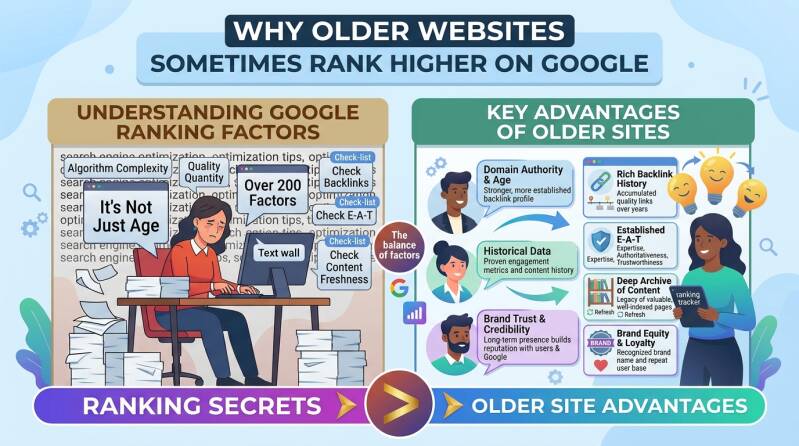
Older websites sometimes have advantages that have developed over many years, including established content, relevant backlinks, recognised brand names and a history of attracting visitors. These advantages can make it difficult for a newer competitor to gain visibility, even when its website looks better.
Understanding these differences can help you identify what needs improving rather than assuming your website is being penalised simply because it is new.
Does Google Give Older Websites Preferential Treatment?
One of the most persistent SEO misconceptions is that Google automatically favours older websites.
The reality is more complicated.
Google has not established a simple rule that gives websites higher rankings purely because their domains have existed for longer. A domain registered 15 years ago does not automatically outrank a domain registered last year.
Instead, Google's ranking systems evaluate many aspects of a page and its relevance to a particular search. These include the content, the query being searched, the overall context and various signals that help Google determine which results may be useful.
An older website may have accumulated advantages over time, but that is different from Google rewarding age itself.
Consider two Melbourne accountants. One has operated a website for 12 years, while the other launched a website six months ago. The established accountant has published dozens of useful articles, earned links from relevant organisations and built a recognisable name in the local market.
The newer accountant may have a more attractive website, but it has had less time to develop the same online presence.
The older website's advantage is not necessarily its age. It is what the business has built during that time.
This distinction matters because it changes the question from "How old does my website need to be?" to "What can I improve to make my website more relevant, useful and credible?"
1. Older Websites May Have More Established Backlinks
Backlinks are links from other websites that point to your website. They can help search engines discover content and are among the signals Google's systems may use when assessing pages.
An established business may have accumulated relevant backlinks through years of industry participation, customer relationships, professional associations, useful content and genuine online references.
For example, an established building company might have links from suppliers, industry directories, local organisations and publications that have mentioned its work.
A new competitor may have none of these connections.
This can create a competitive disadvantage, particularly for searches where several businesses offer similar services and have comparable on-page content.
However, not all backlinks are equally useful. A link from a relevant, reputable website can be more valuable than numerous links from unrelated or low-quality sites. Buying large quantities of links in an attempt to manipulate rankings can also create problems under Google's spam policies.
For a new business, the sensible approach is to build relevant connections gradually. This might involve joining appropriate industry associations, developing relationships with complementary businesses, creating genuinely useful resources or earning references from organisations familiar with your work.
You do not need to reproduce everything an established competitor has done over the past decade. You need to identify opportunities that are relevant to your business and build your own credible online presence.
2. Established Websites Often Have More Content
A business website that has been operating for many years may contain dozens or even hundreds of pages covering its services, customer questions and industry expertise.
That content can help Google understand the subjects the business addresses and the searches for which its pages may be relevant.
Imagine an established plumbing company with separate pages for hot water installations, blocked drains, emergency plumbing, leak detection and bathroom renovations. It also has useful articles answering common questions about these services.
A newer competitor might have a homepage, a contact page and one general services page.
Even if the newer website has a better design, it provides less detailed information about the company's individual services.
This does not mean that publishing more pages automatically improves rankings. A website filled with repetitive, thin or unhelpful content is not necessarily better than a smaller website with a handful of excellent pages.
The objective is to provide sufficient information to address the needs of your customers.
Start by identifying your main services and determining whether each one is explained clearly. Where appropriate, create dedicated service pages that describe what you offer, who the service is for, the problems it addresses and how customers can get started.
You can also publish useful articles that answer genuine customer questions.
Over time, this approach can build a more comprehensive website without creating unnecessary pages simply to increase the total.
3. Older Websites May Have Stronger Brand Recognition
Search engines are not the only influence on how customers discover businesses. Brand recognition can also affect how people interact with search results.
A company that has operated in the same market for many years may be familiar to customers, suppliers and other organisations. People may search for its name directly, mention it in online discussions or refer others to its website.
This recognition can develop through reliable service, professional relationships, advertising, local involvement and other business activities.
A newer competitor may have an equally capable team but lack that established reputation.
For example, someone searching for an electrician might recognise a business they have seen on work vehicles around their suburb. When that company's name appears in Google, the searcher may be more inclined to investigate it.
This does not mean Google simply awards higher rankings to the most familiar brand. Brand recognition and search rankings are not the same thing, and familiarity alone does not guarantee a prominent position.
Nevertheless, establishing a clear, consistent identity across your website and relevant online profiles can help customers recognise and verify your business.
Make sure your website clearly identifies the company, explains its services and provides accurate contact information. Where appropriate, include genuine information about your experience, qualifications and the people behind the business.
For small businesses, credibility is built through real evidence rather than exaggerated claims.
4. The Older Website May Match Search Intent Better
One of the most important reasons an older website might outrank a newer competitor has nothing to do with its age.
It may simply answer the searcher's question more effectively.
Search intent refers to what someone is trying to accomplish when entering a query into a search engine.
A person searching for "emergency plumber Melbourne" probably wants to find a plumber who can respond to an urgent problem. Someone searching for "how does a heat pump hot water system work?" is more likely looking for an explanation.
Although these searches concern related subjects, they require different types of content.
An established business may already have pages that address these needs clearly, while a newer website may use generic descriptions that fail to match the searcher's requirements.
For example, a page titled "Our Services" containing a few paragraphs about plumbing might be less relevant to a specific emergency plumbing search than a dedicated page explaining the company's emergency services, operating hours, service area and contact process.
The solution is not to repeat keywords as frequently as possible. It is to understand what the searcher needs and provide a page that addresses that need.
Review the search results for your important keywords and consider what the better-performing pages provide. Look at their structure, the questions they answer and the information that helps visitors make decisions.
Use these observations to identify gaps in your own content, rather than copying competitors or assuming that longer pages will always rank better.
5. Older Websites May Have Stronger Technical Foundations
A website can look impressive while still having technical problems that affect how search engines access or interpret its content.
Equally, an older website may have a relatively simple design but a technically sound structure that allows search engines to crawl and index its important pages.
Relevant technical considerations include whether pages can be accessed, whether important content is indexable, whether links work correctly and whether the website functions well on mobile devices.
Page speed and overall user experience also deserve attention, although neither guarantees higher rankings on its own.
For a new business website, it's worth checking that important pages are not accidentally blocked from indexing and that the site has a logical navigation structure.
You should also check for broken links, unnecessary redirects and problems that make pages difficult to use.
Google Search Console provides tools for inspecting individual URLs and reviewing indexing information. These can help identify issues that deserve investigation.
However, avoid treating every warning from an SEO tool as a critical problem. Some technical recommendations have little practical impact on rankings, while other issues can prevent important pages from appearing in search results at all.
Prioritise corrections according to their likely effect on accessibility, usability and search performance.
6. Your Competitors May Have More Relevant Local Signals
For Australian businesses serving particular towns, suburbs or regions, local search visibility can be especially important.
A newer business may have a professional website but an incomplete Google Business Profile, inconsistent business information or limited customer feedback.
An established competitor may have a complete profile, accurate operating details, genuine reviews and a stronger history of local business activity.
These differences can influence how customers discover and evaluate local businesses.
Google explains that local search results are influenced primarily by relevance, distance and prominence. Reviews and links are among the factors that can contribute to prominence, although local ranking systems consider multiple signals.
This does not mean that the business with the most reviews will always rank first, or that an older business automatically receives preferential treatment.
It means local visibility requires attention to more than the website alone.
Start by ensuring your Google Business Profile accurately represents your business, including your services, opening hours and service areas where applicable. Keep your website and other important business listings consistent, and make it easy for genuine customers to leave honest reviews.
LabRank Digital's Local SEO Services focus on these practical foundations through Google Business Profile optimisation and relevant directory listings.
For businesses that depend on local customers, these improvements can help establish a stronger online presence without requiring an expensive website rebuild.
7. The Older Website May Have Had More Time to Develop Useful Content
SEO improvements do not always produce immediate results.
After publishing a new page or making substantial changes to an existing one, search engines need to discover the content, crawl it and assess how it relates to relevant queries. Changes in search visibility can take time, and outcomes are not guaranteed.
An older competitor may have developed its website progressively over many years, refining content, correcting problems and responding to changes in its industry.
Its pages may also have accumulated references and a history of appearing in relevant search results.
A new website has less historical activity to draw on, but this does not mean it must wait years before competing.
The speed at which a website gains visibility depends on many factors, including the competition, the quality and relevance of its content, the search terms being targeted and the overall state of the website.
Some new pages can gain visibility relatively quickly for appropriate searches, while highly competitive terms may require sustained effort.
The important thing is to avoid expecting a new website to outperform established competitors immediately simply because it has been designed more recently.
Instead, establish realistic priorities and monitor progress over time.
How Can a New Website Compete With Older Competitors?
If your website is relatively new, the most productive response is to identify the advantages your competitors have developed and determine which ones you can realistically address.
You do not need to match every aspect of an established competitor's online presence. You need to make your own website a strong and relevant option for the searches that matter to your business.
Focus on Specific, Relevant Keywords
Broad search terms can be highly competitive, particularly when they target popular services across large geographic areas.
A new business may have a better opportunity by targeting more specific searches that closely match its offerings.
For example, rather than focusing exclusively on a broad term such as "accountant", an accounting firm might investigate relevant searches involving small-business bookkeeping, company tax returns or accounting services in its actual service area.
The right keywords depend on the business, the competition and the way potential customers search.
Specificity does not guarantee easier rankings, and search volume alone should not determine which keywords you target. The goal is to identify searches that are relevant to your services and have a realistic commercial purpose.
Build Strong Service Pages
Make sure your most important services have clear, useful descriptions.
Explain what the service involves, who it is suitable for and how customers can arrange it. Address common questions and provide relevant details that help people make informed decisions.
Avoid creating multiple pages that repeat essentially the same content with minor keyword changes.
A smaller collection of well-developed pages can provide a stronger foundation than a large website filled with overlapping material.
Earn Relevant Backlinks Naturally
Look for legitimate opportunities to build professional relationships and earn references from relevant websites.
This might involve industry associations, suppliers, complementary service providers or organisations that have a genuine reason to mention your business.
You can also develop useful resources that others may wish to reference.
The emphasis should be on relevance and credibility, not the number of links acquired each month.
Make Your Website Easy to Use
A technically accessible website with clear navigation and useful content provides a sound foundation for SEO.
Check that visitors can find your services, understand what you offer and contact you without unnecessary difficulty.
Review important pages on mobile devices, ensure contact information is easy to locate and correct technical issues that prevent search engines or users from accessing content.
These improvements support the overall effectiveness of the website, even when they do not produce an immediate ranking change.
Measure Progress Rather Than Guessing
Google Search Console can help you monitor impressions, clicks, search queries and average positions for your website.
Use this information to identify which pages are gaining visibility and where opportunities may exist.
If a page is appearing for relevant searches but attracting few clicks, investigate its search snippet, position and alignment with the query. If it receives little visibility, examine whether the content is sufficiently relevant, whether the page is indexed and how competitive the targeted search may be.
Review performance over appropriate periods rather than reacting to daily fluctuations.
This allows you to make decisions based on evidence instead of assuming that age, design or a single ranking factor explains every difference between your website and a competitor's.
Does This Also Apply to AI Search?
The same general principle applies when considering AI-assisted search experiences: having an older website does not guarantee that a business will be mentioned or recommended.
AI systems may retrieve information from websites and other sources when answering questions. The sources selected can depend on the query, the platform and the information available.
An established business might have a larger collection of useful pages and more references across the web, while a newer business may have less publicly available information.
However, there is no reliable rule stating that AI search systems prefer older websites simply because they have existed for longer.
Businesses should focus on maintaining accurate information, explaining their services clearly and ensuring their websites are technically accessible.
Useful content, relevant business details and credible references can support discoverability, but they do not guarantee inclusion in AI-generated answers.
The best strategy is to establish a strong website that serves customers well and provides clear information about the business, regardless of which search interface people use.
How Much SEO Work Does Your Website Actually Need?
It's easy to assume that competing against older websites requires an extensive SEO campaign and a large marketing budget.
In reality, the appropriate amount of work depends on the website's current condition, the competition and the business's objectives.
Some websites need substantial technical corrections or better service pages. Others already have a reasonable foundation and may benefit from more targeted improvements, relevant content and consistent local optimisation.
The important thing is to identify the actual weaknesses before committing resources.
At LabRank Digital, we focus on making SEO more accessible to small businesses through practical, ongoing optimisation. Our SEO Pricing Plans outline an affordable approach for businesses that want to improve their online visibility without the expense of a traditional large-agency arrangement.
A sensible SEO programme should establish clear priorities, explain the work being undertaken and monitor progress using relevant performance measures. It should not promise guaranteed rankings or suggest that every business needs the same strategy.
For many small businesses, improving the website progressively is more manageable than attempting a complete overhaul without a clear reason.
You can also learn more about our experience and approach on the About LabRank Digital page.
Final Thoughts
Older websites sometimes rank higher because they have developed advantages over time: relevant backlinks, useful content, recognised brands, stronger local information and pages that closely match what searchers need.
But age alone is not a reliable explanation for higher rankings, and a new website is not automatically disadvantaged forever.
A newer business can compete by understanding its customers, targeting relevant searches, building useful service pages and establishing a credible online presence.
Rather than trying to copy everything an established competitor has done, identify the areas where your website falls short and address them systematically.
Google does not require your website to be old. It needs to be a relevant and useful result for the search being performed.
Building that relevance and credibility takes work, but it does not necessarily require a large budget or a complicated SEO strategy. With sensible priorities and consistent improvements, small businesses can establish a stronger foundation for visibility in Google Search and evolving AI-assisted search experiences.
The goal is not to make your website look older. It is to make it a better answer for the customers you want to reach.
Add comment
Comments