

When potential customers visit your website, they want to understand what your business offers, whether you can solve their problem and why they should consider choosing you. If your service descriptions are vague, overly technical or difficult to follow, visitors may leave without making an enquiry.
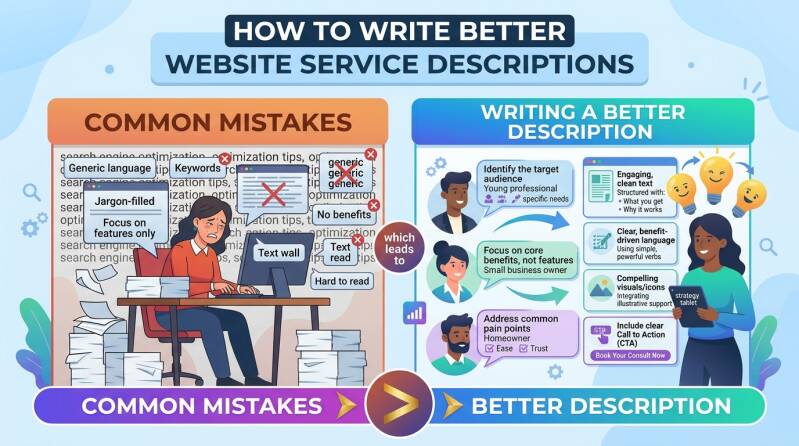
Many small-business websites contain descriptions that sound professional but provide very little useful information. Phrases such as "we deliver quality solutions", "customer satisfaction is our priority" and "we offer a comprehensive range of services" might describe almost any business. They do little to explain what makes a particular service relevant to a customer's needs.
Effective service descriptions do more than fill space on a website. They help visitors understand your offerings, answer practical questions and decide what to do next. They can also support search engine optimisation by making the purpose of each page clearer to search engines.
The good news is that improving your website content does not necessarily require a complete redesign or an expensive copywriting project. By focusing on clarity, relevance and the information customers actually need, you can make your existing service pages more useful while building a stronger foundation for search visibility.
1. Explain Exactly What Your Business Offers
One of the most common problems with service pages is that they describe the business in broad terms without explaining what customers can actually purchase.
Consider a cleaning company whose website states:
"We provide professional cleaning solutions tailored to your needs."
Although this sounds reasonable, it leaves several important questions unanswered. Does the company clean homes, offices or industrial facilities? Does it offer regular cleaning, end-of-lease cleaning or specialised services? Which customers is it equipped to help?
A more informative description would identify the specific service and explain what it involves.
For example, a commercial cleaning company might explain that it provides scheduled office cleaning, including cleaning workstations, maintaining shared kitchen areas, sanitising bathrooms and managing general waste. It could also describe the types of workplaces it serves and explain how businesses can arrange an initial assessment.
This gives prospective customers a much clearer understanding of the offering.
Start by reviewing each service page on your website. Ask whether someone unfamiliar with your business could read the page and understand precisely what you do. If the answer is no, replace vague descriptions with specific, accurate information.
You do not need to explain every operational detail. The objective is to give visitors enough information to determine whether the service is relevant to them.
2. Write for Your Customers, Not Just Search Engines
Search engine optimisation is important, but service descriptions should primarily help people make informed decisions.
A page written around repeated keywords rather than customer needs can quickly become difficult to read. For example, a Melbourne electrician who repeatedly uses phrases such as "electrician Melbourne", "Melbourne electrician services" and "best electrician Melbourne" throughout every paragraph may produce awkward copy without adequately explaining the actual services.
Instead, consider the questions customers are likely to ask before contacting you.
What problem does the service solve? Who is it suitable for? What does the process involve? Are there any important requirements or limitations? What should the customer do to get started?
Answering these questions naturally can make your content more useful while helping you incorporate relevant terminology in context.
For instance, an electrical contractor could explain the warning signs that suggest a switchboard needs assessment, what a professional inspection involves and why the work should be carried out by a suitably licensed electrician.
The page can still mention the relevant service and location where appropriate, but these terms should fit naturally into the explanation.
Good website copy does not force customers to read around keywords. It makes the information they need easy to find and understand.
3. Give Each Important Service Its Own Clear Focus
Businesses offering several services sometimes try to describe everything on a single page. Although this may seem convenient, it can make the website harder to navigate and limit the amount of useful information available about individual offerings.
Imagine a landscaping company that provides garden design, paving, retaining walls, irrigation installation and ongoing garden maintenance. If all five services receive only a short paragraph on one general page, customers may struggle to find detailed information about the particular work they need.
Creating separate pages for significant services can provide room to explain each offering properly.
A dedicated garden design page, for example, could describe the planning process, the types of projects undertaken, the factors that influence a design and what customers should prepare before requesting a consultation.
A separate irrigation page could focus on system installation, water efficiency, maintenance requirements and the properties for which the service is suitable.
This structure can also help search engines understand the purpose of individual pages and how they relate to particular search queries.
However, separate pages are not necessary for every minor variation of a service. If two offerings are substantially similar and serve the same customer need, dividing them into multiple pages may create unnecessary duplication.
The right approach depends on the complexity of your services, the questions customers ask and whether each proposed page would provide meaningful, distinct information.
4. Use Headings That Tell Visitors What to Expect
Headings help visitors scan a page and locate the information that matters to them. They also contribute to the organisation and accessibility of your content.
A service page should have a clear main heading that identifies the service. Supporting headings can then introduce the key details, such as what's included, how the process works, who the service is for and how to arrange an appointment.
For example, a website describing bookkeeping services might use headings such as:
- What Our Bookkeeping Service Includes
- Who Can Benefit From Professional Bookkeeping?
- How Our Bookkeeping Process Works
- Getting Started With Our Team
These headings establish a logical structure and make the page easier to navigate.
Avoid using headings merely to repeat variations of the same keyword. A heading should introduce useful information, not exist solely to accommodate another search term.
Use your website's heading structure consistently, with a clear main heading and appropriately organised subheadings. This helps readers understand the relationship between different sections and makes the content easier to maintain.
A well-organised page also allows you to add information in the future without turning the entire description into one long, difficult-to-read block of text.
5. Explain the Benefits Without Making Unrealistic Promises
Customers generally want to understand how a service will help them, not simply what tasks a business performs.
A web developer, for example, might explain that its website maintenance service includes software updates, routine checks and assistance with technical problems. It could then describe the practical benefits of keeping a website maintained, such as reducing avoidable technical issues and helping the business keep its online information current.
This connects the service's activities with the customer's needs.
However, there is an important distinction between explaining a genuine benefit and promising an outcome you cannot guarantee.
A business should not claim that every customer will save a particular amount of money, achieve a specific result or avoid every possible problem unless there is a defensible basis for that statement.
The same principle applies to SEO service descriptions. An SEO provider can explain how its work is intended to improve website structure, content relevance and search visibility, but it should not guarantee a number-one Google ranking.
For small businesses, clear and realistic explanations are often more persuasive than exaggerated claims.
Describe what you actually do, explain why the work matters and identify the outcomes customers may reasonably expect without presenting uncertain results as guaranteed.
6. Include the Details Customers Need Before Making Contact
A service page should help prospective customers determine whether your offering suits their circumstances.
Depending on the business, useful details may include the service area, typical project requirements, the process for requesting a quote, relevant qualifications, available appointment types or factors that influence pricing.
For example, a residential painter might explain whether the business handles interior painting, exterior painting or both, what information is required to prepare a quote and whether customers need to arrange an inspection before receiving an estimate.
This reduces uncertainty and can make subsequent conversations more productive.
You do not need to publish every commercial detail on your website. Some services require an individual assessment before a price can be established. In those cases, explain the factors that influence the cost and what customers can expect during the quoting process.
The key is to avoid making visitors guess about important aspects of the service.
If you serve customers across particular suburbs or regions, identify those areas accurately where relevant. LabRank Digital's Local SEO Services can help small businesses establish clearer local business information through Google Business Profile optimisation and relevant directory listings.
Accurate service descriptions and consistent local information provide a useful foundation for customers researching businesses in their area.
7. Incorporate Keywords Naturally
Keywords remain useful when developing website content because they help you understand the language people use when searching for your services.
However, keyword selection should follow an understanding of the service and the customer, rather than dictate every sentence on the page.
Suppose a Melbourne business provides residential pest control. Relevant search terms might include "residential pest control Melbourne" and specific service-related phrases that reflect the work it performs.
Those terms may belong naturally in the page title, main heading or body content where they accurately describe the offering.
The business should not force the same phrase into every paragraph or create awkward sentences simply to increase keyword frequency.
Search engines use more than exact keyword matches to interpret pages. The overall content, its context and how well it addresses the search query also matter.
Before rewriting a service page, identify its main purpose and the search terms most closely associated with that purpose. Then write a clear explanation of the service, incorporating relevant terms where they genuinely fit.
If you are unsure which searches matter most, Google Search Console can provide information about the queries for which your existing pages receive impressions and clicks.
This can help identify whether a page already attracts relevant searches and where the content might need further refinement.
8. Demonstrate Experience and Credibility
Customers may hesitate to contact a business if they cannot establish whether it has the experience or expertise required for the job.
Service descriptions provide an opportunity to address that concern with accurate, relevant information.
Depending on your industry, this might include professional qualifications, licences, certifications, relevant experience, examples of completed projects or the types of customers you regularly serve.
For example, a business providing commercial electrical services could explain the relevant work it undertakes, identify applicable qualifications and describe its experience with the types of premises it serves.
Claims should be specific and verifiable. Avoid vague assertions such as "Australia's leading provider" unless the statement can be substantiated and is appropriate to use.
You can also link to relevant case studies, testimonials or portfolio pages where these provide useful evidence of your work.
A service description does not need to contain every detail about your business history. It should include enough relevant information to help prospective customers assess your suitability.
For more information about the experience behind LabRank Digital, visit the About LabRank Digital page.
Credibility comes from clear information and genuine evidence, not from simply describing a business as trustworthy.
9. Make the Next Step Obvious
Even a well-written service page can be less effective if visitors cannot work out what to do next.
Once someone understands your service and decides it may be suitable, provide a clear way to proceed.
Depending on the business, this could mean requesting a quote, booking an appointment, calling the office or completing an enquiry form.
The wording should reflect the actual next step. A business that offers consultations might use a prompt inviting visitors to arrange a consultation, while a trades business may encourage customers to request a quote.
Make sure the relevant button, contact details or form is easy to find and works correctly on mobile devices as well as desktop computers.
Avoid overwhelming visitors with several competing calls to action. A page should make the most appropriate next step clear without forcing people through an unnecessarily complicated process.
You should also ensure that any claims about response times, availability or the quoting process reflect how your business actually operates.
The objective is to make contacting your business straightforward while setting realistic expectations about what happens afterwards.
10. Review Existing Service Pages Before Creating More
Improving your website does not always mean adding more pages.
In many cases, the most practical starting point is to review the content you already have and identify which pages would benefit from attention.
Begin with your core services and assess whether each page clearly explains the offering, answers important customer questions and provides an appropriate next step.
Look for outdated information, vague descriptions, missing details and sections that repeat the same message without adding value.
Where possible, use performance data to guide your priorities. A page that already attracts relevant search impressions may offer a useful opportunity for improvement, while a technically inaccessible page may require a different type of correction.
You should also check whether several pages target essentially the same service and search intent. If so, consider whether their content needs to be differentiated, consolidated or reorganised.
Make changes for a clear reason rather than rewriting every page simply because it has existed for a while.
If your website has many services, work through them in stages. Improving the most commercially important pages first can make the project more manageable and help you focus your resources where they are most needed.
For more practical advice about website content and search visibility, explore the LabRank Digital News section.
How Better Service Descriptions Support SEO
Clear service descriptions can support SEO by helping search engines understand what individual pages offer and how their content relates to relevant searches.
They can also improve the experience for visitors who arrive through Google or other discovery channels.
However, well-written content does not guarantee a particular ranking. Search visibility depends on multiple factors, including competition, technical accessibility, relevance, the quality of the wider website and the specific query being searched.
Similarly, clear service descriptions may help AI-assisted search systems interpret the information presented on your website, but they cannot guarantee that your business will appear in an AI-generated answer or recommendation.
The practical objective is to make your website informative, accessible and relevant to the people you want to reach.
For a small business, this is a sensible investment because the same improvements can help customers understand your services regardless of how they discover your website.
Affordable SEO Starts With the Right Improvements
Small businesses do not always have the budget to commission an extensive website rewrite or undertake a complete redesign. Fortunately, improving service descriptions can often begin with a focused review of existing content.
Identify the pages that matter most, correct vague or outdated information, organise the content logically and make sure visitors can easily take the next step.
Then monitor performance and decide where further work is justified.
At LabRank Digital, our focus is on making SEO accessible to small businesses through practical, ongoing optimisation. Our SEO Pricing Plans outline an affordable approach for businesses looking to improve their search visibility without the cost of a traditional large-agency arrangement.
The appropriate work will depend on your website's current condition, the services you provide and the competition in your market. What matters is having a clear reason for each improvement and concentrating on changes that make your website more useful to prospective customers.
Final Thoughts
Your website's service descriptions should do more than announce what your business does. They should help customers understand the service, assess whether it meets their needs and decide how to proceed.
Start by replacing vague statements with specific information. Organise your pages around individual services where appropriate, use relevant keywords naturally, demonstrate credibility and make contacting your business straightforward.
Avoid creating unnecessary pages or repeating keywords in the hope of forcing better rankings. Instead, focus on producing content that accurately reflects your services and answers the questions customers are likely to ask.
A good service description makes your offering clear to customers and gives search engines useful information about the page.
These improvements will not guarantee higher Google rankings or AI search visibility, but they can strengthen your website's foundations and create a better experience for potential customers.
For small businesses, that is a practical place to start building a website that supports both online visibility and genuine commercial enquiries.
Add comment
Comments