

When small businesses think about search engine optimisation (SEO), they often focus on keywords. They may try to include a particular phrase in their homepage, service descriptions, headings and blog articles as many times as possible, hoping that Google will recognise the page as relevant and rank it more prominently.
Keywords are important because they help search engines understand what a page is about. However, simply repeating a phrase does not guarantee better rankings. A more useful question is whether the page provides the information, service or solution that someone was actually looking for when they entered that search.
This is where search intent becomes important. Understanding search intent helps businesses create website content that is relevant to potential customers, answers their questions and makes it easier for them to take the next step. For small businesses working with limited marketing budgets, getting this right can make existing website content considerably more useful without necessarily requiring a complete redesign or a large volume of new pages.
What Is Search Intent?
Search intent is the underlying reason someone performs a search. The words entered into Google provide clues about what the person wants, but those words do not always tell the entire story. Someone might be looking for information, comparing available options, searching for a particular business or trying to purchase a product or service immediately.
Consider the difference between someone searching for “what is roof restoration” and someone searching for “roof restoration company near me”. Both searches concern roof restoration, but the people performing them are likely at different stages of their decision-making process.
The first person may be researching a problem, learning about available solutions or deciding whether restoration is appropriate. The second is more likely to be looking for a business that can provide the service. A website page that explains the restoration process might satisfy the first search, while a well-developed service page with information about the business, its service area and how to request a quote is more likely to meet the second person's needs.
If a business understands these differences, it can create pages that serve a clear purpose rather than trying to make every page appeal to every possible search.
The Four Common Types of Search Intent
Search intent is often grouped into four broad categories. These are useful starting points when planning website content, although real searches do not always fit neatly into a single category.
1. Informational intent
Informational searches occur when people want to learn something, understand a problem or find an answer to a question. Examples include “how often should gutters be cleaned”, “why is my website slow” and “what does an accountant do for a small business”.
Businesses can address these searches through useful articles, guides, frequently asked questions and educational resources. This content can introduce potential customers to the business and demonstrate that it understands the problems they are trying to solve.
However, informational content should provide genuine value rather than simply using a question as an excuse to advertise. A useful article about gutter maintenance, for example, should explain the relevant considerations before inviting readers to explore a professional cleaning service.
2. Navigational intent
Navigational searches happen when someone wants to find a particular business, website or destination. A person searching for a company's name, followed by “contact” or “opening hours”, is probably trying to reach that business rather than discover an alternative.
For businesses, accurate contact information, clear website navigation and a properly maintained Google Business Profile can help customers find the right destination. Consistent business details and a website that is easy to use also reduce unnecessary friction when people are trying to get in touch.
3. Commercial investigation
Commercial investigation occurs when people are comparing options before making a decision. Searches such as “best accounting software for small business”, “affordable SEO agency” and “timber flooring versus laminate” suggest that the person is evaluating alternatives.
Useful content for these searches might include detailed service descriptions, pricing information, comparisons, explanations of what is included in a service and answers to common buying questions. Businesses should help potential customers understand their options and determine whether the offering is suitable for their needs.
For example, an SEO agency that explains its pricing, deliverables and intended customer base gives prospective clients more information to work with than a website containing little more than a list of SEO services.
4. Transactional intent
Transactional searches indicate that someone is closer to taking action. They may be ready to book an appointment, request a quote, make a purchase or arrange a consultation.
A search such as “emergency plumber in Melbourne” can indicate an immediate need. The most useful destination is likely to be a relevant service page that clearly explains the service, establishes the business's location or coverage area and makes contact straightforward.
A strong transactional page should not force visitors to navigate through several unrelated pages to find a telephone number, booking form or quote request option. The next step should be obvious and appropriate to the service being offered.
Understanding these four categories gives businesses a practical way to assess whether their website content matches what potential customers are trying to accomplish.
Why Repeating Keywords Is Not Enough
Imagine a Melbourne business that provides commercial cleaning services. It wants to attract customers searching for “commercial cleaning Melbourne”, so it repeats that phrase throughout its homepage and service pages.
Although the wording identifies the general service and location, repetition alone does not explain what the business offers, which customers it serves or why someone should consider contacting it. If visitors cannot quickly determine whether the company handles offices, retail premises or industrial facilities, the content may not answer their questions.
A more effective page would naturally incorporate the relevant search terms while explaining the services available, the types of premises covered, the geographical service area and the process for obtaining a quote. It could also address practical concerns, such as scheduling, ongoing cleaning arrangements or the scope of work.
The objective is not to remove keywords. It is to use them in context and provide enough relevant information to meet the visitor's needs.
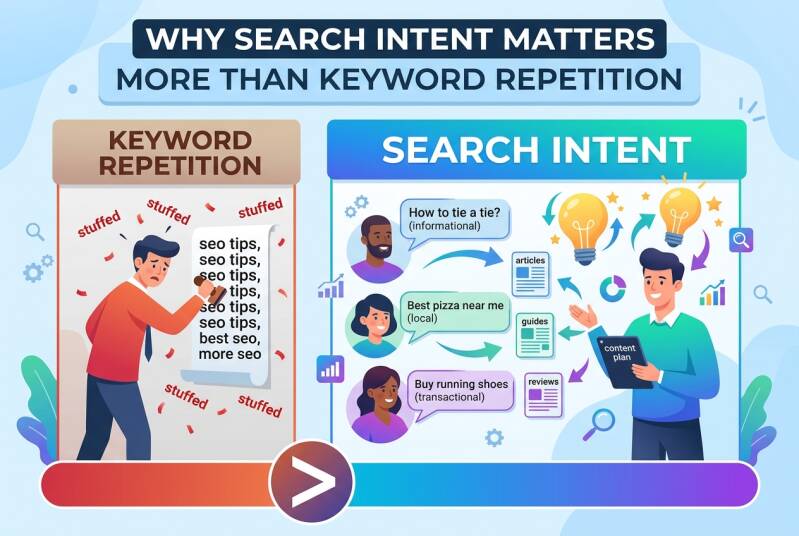
Excessive repetition can make content awkward to read and may create the impression that a page was written primarily for search engines rather than people. Google advises website owners to prioritise helpful, reliable, people-first content. There is no universal keyword density that guarantees a page will rank, and repeating a target phrase a particular number of times is not a substitute for relevance, usefulness and sound website structure.
How to Identify the Intent Behind a Search
Businesses do not need expensive SEO software to begin understanding search intent. A practical starting point is to examine the actual searches they want to attract and consider what a person would reasonably expect to find.
One useful method is to search the target phrase in Google and examine the types of results that appear. Are the results predominantly service pages, product listings, explanatory articles, comparison guides or local business listings? The pattern can provide clues about the type of content Google considers relevant to that search.
For example, someone targeting “how to improve website speed” should expect to find educational content addressing the problem and explaining potential solutions. A page that immediately pushes a paid service without answering the underlying question may be less useful than a guide that explains the issue and then offers professional assistance as an option.
By contrast, a search for “website speed optimisation service” indicates a more service-oriented need. In that situation, a page explaining the service, its benefits, the process and how to request assistance may be more appropriate.
Search results are not a perfect measure of what every individual wants, and they can vary by location, device and other circumstances. Nevertheless, they provide a practical source of evidence when deciding what a page should contain.
Businesses can also use Google Search Console, where available, to examine the queries that generate impressions and clicks for their website. If a page appears for searches that suggest a different need from the one the page addresses, that may indicate an opportunity to improve the content or create a more suitable destination.
Match the Page to the Customer's Need
Once the likely intent is understood, the next step is to make sure the website has an appropriate page for it. This does not mean creating a separate page for every minor variation of a keyword. It means making sure that the important needs of potential customers are covered without producing unnecessary or repetitive content.
A business offering several related services, for example, should consider whether each major service needs its own page. A single generic page may struggle to explain the differences between services, address the specific questions customers have and make the relevance of each offering clear.
A dedicated service page can provide more focused information, provided that it contains meaningful content rather than simply repeating the same material under a different heading.
For a local business, a well-developed service page might explain:
- What the service includes and which problems it addresses.
- Who the service is suitable for.
- The locations or areas the business genuinely serves.
- What customers can expect from the process.
- Common questions, limitations or considerations.
- How to request a quote, book a service or make an enquiry.
Not every service page needs every item on this list. The content should reflect the service itself and the information customers need before deciding whether to proceed.
The same principle applies to educational articles. An article should answer its central question thoroughly enough to be useful, organise the information logically and link to relevant services when those services offer a natural next step.
This approach helps businesses build a website where each important page has a clear role, rather than a collection of pages competing to address the same search.
Search Intent and Local SEO
Search intent is particularly relevant to local businesses because customers often include a location, a service area or an indication of urgency in their searches.
Someone searching for “electrician in Geelong” is likely to want a local service provider. Someone searching for “why does a circuit breaker keep tripping” may be trying to understand an electrical problem before deciding whether professional assistance is necessary.
Both searches could be valuable to an electrical business, but they require different approaches.
A local service page should make the service and relevant location clear, explain what the business does and provide straightforward contact options. An educational article should focus on the question, explain the issue in accessible language and avoid encouraging readers to undertake dangerous electrical work themselves.
A business should also ensure that its location claims are accurate. Creating pages for suburbs where it does not genuinely operate, or producing many near-identical location pages with only the suburb name changed, is unlikely to be a sound long-term strategy.
Local visibility depends on more than the wording of website pages. Google Business Profile information, relevance to the search, the searcher's location and other factors can influence local results. A website that aligns its content with customer needs is an important part of the overall approach, but it cannot guarantee a particular position in Google Maps or ordinary search results.
Businesses looking to strengthen their local presence can explore LabRank Digital's local SEO services to understand how local optimisation fits into a broader SEO effort.
Does Search Intent Matter for AI Search as Well?
Search behaviour continues to evolve as people use AI-powered search features and conversational tools to ask questions, compare options and explore recommendations. Instead of entering a short phrase, someone might ask a longer question that describes their circumstances and the outcome they want.
For example, a person might ask, “What should I look for in an affordable SEO service for a small business?” That question contains several needs: the person wants to understand what the service should include, how to assess affordability and which factors matter when comparing providers.
A useful website should address those underlying questions clearly. Explaining the services provided, the intended customer, the pricing structure and the limitations of what SEO can achieve gives readers more meaningful information than repeating the phrase “affordable SEO” throughout the page.
This does not mean businesses need to write content specifically for every possible AI question. Clear explanations, useful information, well-organised pages and accurate business details are sensible foundations for both conventional search and newer discovery experiences.
However, no particular writing technique can guarantee that an AI-powered search feature will mention a business. These systems select and present information in different ways, and visibility will depend on factors that a business cannot fully control.
The practical objective remains the same: make the website a useful, trustworthy source of information for the people the business wants to reach.
How to Review Your Existing Website Content
Before commissioning new content, it is worth reviewing the pages that already exist. Some may contain useful information but fail to answer the questions visitors are likely to have. Others may target several different topics without adequately addressing any of them.
Start with the pages that matter most commercially, such as the homepage and your main service pages. For each page, consider the following questions:
-
What is the main purpose of this page? Decide whether it should educate visitors, help them compare options, attract local service enquiries or support another clearly defined objective.
-
What would a visitor reasonably expect to find? Compare the page with the questions, concerns and practical requirements associated with the target search.
-
Does the content answer those questions? Look for missing details, vague descriptions, unsupported claims and information that forces visitors to search elsewhere.
-
Is the next step clear? Where appropriate, make it easy for visitors to contact the business, request a quote, book an appointment or explore a related service.
-
Does the page overlap unnecessarily with other pages? If several pages target essentially the same need, consider whether they should be improved, consolidated or given more distinct purposes.
-
Can the page be improved without starting again? Better headings, clearer explanations, more useful examples and stronger internal links may be enough to make an existing page more effective.
Once improvements are made, allow time for search engines to recrawl and reassess the updated content. Rankings and traffic can fluctuate, so evaluate performance over an appropriate period rather than expecting immediate results.
Google Search Console can help you monitor impressions, clicks and the queries associated with a page. Website analytics may provide additional insight into whether visitors engage with the content or take the actions that matter to the business.
The goal is not simply to attract more visitors. It is to attract relevant visitors and help them find what they came looking for.
Better SEO Starts With Understanding Your Customers
Search intent is a useful reminder that effective SEO begins with the customer, not a keyword list. Keywords help identify the subjects people search for, but the content must go further by providing information that matches their needs and helps them make informed decisions.
For small businesses, this can be a practical way to improve website performance without continually adding more pages or investing in a complete redesign. Reviewing important pages, clarifying their purpose and answering customer questions can make existing content more useful while giving search engines clearer signals about what each page offers.
SEO remains a long-term process, and improvements do not guarantee specific rankings, traffic levels or sales. Results depend on many factors, including competition, website quality, the relevance of the offering and how people search for it. Nevertheless, a website built around genuine customer needs has a stronger foundation than one built around keyword repetition alone.
At LabRank Digital, the focus is on practical, affordable SEO for small businesses that want to improve their search visibility without unnecessary agency costs or lengthy strategy meetings. If your website attracts little relevant traffic, or its pages do not clearly explain your services, reviewing your content against customer search intent is a sensible place to begin.
You can explore our affordable SEO services and SEO pricing and plans to see how ongoing optimisation may fit your business. For more practical guidance, visit our SEO articles and business resources.
The key takeaway: Do not focus solely on how often a keyword appears on a page. Focus on what the person searching for that keyword actually needs, then make sure your website provides a clear, useful and relevant answer.
Add comment
Comments